Which
snowshoes?
Long
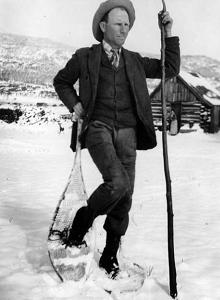
gone are the days of snowshoes resembling
wooden tennis rackets strapped to the feet.
They are from the same era as the clothing
in the photo above! Modern snowshoes
are light, sleek and technical. On this page we offer some advice
that will help you, gained from our experience. To return to the equipment lists and advice pages, please click
here.
We
are in the process of developing these equipment
advice pages for many of the key items of
equipment, in order to help people prepare
better for their trips. We are always editing
these pages, so if you have any feedback about
information we should add to the page, please
let us know.
This
page has largely been written by Emma from our Windermere
HQ, and it's here that most
people have their first contact with us, in
person or on the phone. We feel it's important
that all our staff are experts on the mountains
and kit we offer, so we are all involved in
developing these advice pages.
Types
of terrain encountered for snowshoeing
Snowshoes enable access into similar terrain
to that of ski tourers, and it is generally
rolling nordic type terrain. It is possible
to snowshoe on slopes up to about 30°,
and depending on the type of snowshoe you
use, different snow packs can be crossed,
varying from crusts to powder. To decide what
snowshoe would suit you best is generally
a function of both the terrain you normally
plan to travel over, and also budget and durability.
Selection
of snowshoe equipment
When looking at purchasing a pair of
snowshoes, look for the standards of
construction, as these vary massively
between brands. Here we have mentioned
only the most reputable. Aside of the
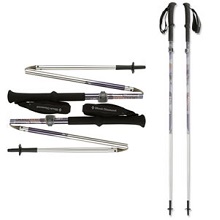
snowshoes, you will require a pair of
trekking poles, with big snow baskets
fitted, as these give you balance, and
reduce the number of falls! Don't carry
too much in your rucksack, as this will
take you off balance, and when walking
uphill make sure you do not wear too
many layers, as you will get warm very
quickly. A litre or two of water will
keep you hydrated through the day. Gaiters
keep snow out of your boots and keep
your lower legs warm when walking in
deep snow. Any sturdy waterproof walking
boot is fine for snowshoeing, as long
as it gives you good ankle support.
When you are being guided, you are provided
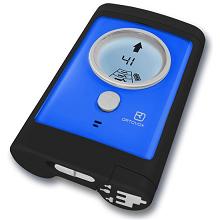
with an avalanche safety kit of a transceiver,
shovel and probe. Good sunglasses are
essential to protect your eyes, and
of course high factor sunscreen. Now
you are ready to go...
Different types
of snowshoe
There are three main types of snowshoe, and
they are discussed in detail below, so you
make the most informed choice possible. All
types are widely available for purchase, both
in equipment shops and on the internet.
What
are snowshoes?
Snowshoeing
was invented around 4000 years ago and snowshoes
were most developed by North American aborigines.
Historically, snowshoes were essential tools for
fur traders, trappers, and anyone whose life or
living depended on the ability to get around in
areas of deep and frequent snowfall.
How they've
changed
Snowshoes today have come a long way from the traditional
hardwood frame with leather laces, and most are
now made of modern materials such as moulded plastic.
The purpose of snowshoes however remains the same,
to ease walking in deep snow through using a frame
fastened to existing shoes in order to create a
larger surface area that reduces the amount a person's
foot sinks into the snow. This is often referred
to as 'floatation', and the more you have, the easier
it is.
Why use snowshoes?
Snowshoes are designed to distribute the weight
of the person over a larger area so your feet do
not sink too deeply into the snow and float higher
in the snowpack when trekking in snow. Snowshoeing
is now officially the fastest growing winter sport,
and the range of snowshoeing courses we offer at
Icicle Mountaineering expands every year to reflect
the demand for the sport.
Our snowshoe
range
We have the largest range of snowshoes of any outdoor
shop in the country! They are selected by our UIMLA
/ BAIML snowshoeing guide team. These are the snowshoes
that we use ourselves, and you can read more about
the British Association of International Mountain
Leaders.
What snowshoe
type?
One of the primary considerations when choosing
which snowshoes are the most suitable for you, is
to consider your own body weight; and in addition,
the weight of the gear you will be carrying when
snowshoeing. The greater the overall weight, the
bigger the surface of the snowshoe. Most snowshoes
have a minimum and maximum overall load weight to
help guide you into choosing the most appropriate
snowshoes. A common formula is that for every pound
of body weight, there should be one square inch
of snowshoe surface (14.5 cm²/kg) per snowshoe
to adequately support the wearer.
Crampon points
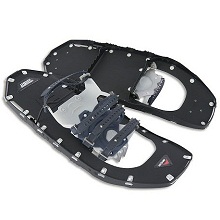
Almost all snowshoes have a crampon directly below
the binding, and more aggressive snowshoes have
additional traction elements near the tail of the
snowshoe, or along each edge. For steep, firm snow
or backcountry terrain, the additional side and
rear crampon points provide more security and traction
on steep uphill, and downhill terrain.
Heel raisers
/ lifts
Most modern snowshoes have heel raisers (sometimes
referred to as heel cleats, or heel lifts) which
you can flip up and assist in ascending a mountain.
By using the heel raiser on ascents you can rest
your boot onto the raiser which then transfers your
weight off the calf muscles and achilles tendons,
and transfer the weight onto to the quads and glutes,
which are the strongest muscle groups in your legs.
Getting advice
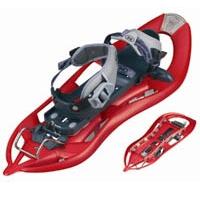
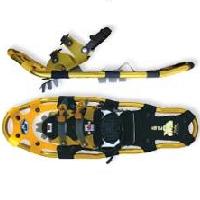
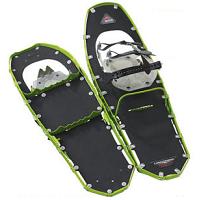
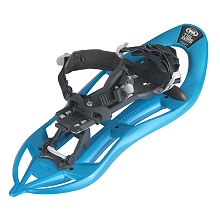
Our Icicle shop in Windermere stocks and sells 6
different sets of snowshoes manufactured by TSL;
and MSR. Here is a quick guide as to which we sell,
and some key points to help you decide which are
best for what you need. If you need any assistance
in deciding which shoeshoes are best for you, visit
our shop and Office in Windermere in the Lake District
for kit and course advice; or see our online shop
(click
here) or email our team with any queries
if you are looking to purchase a set, or wish to
know if an existing pair you have is suitable.
Below
is a table showing the snowshoes we stock in the
Icicle Windermere shop.
Plastic
Moulded
Tubular
Snowshoes
Frame
Snowshoes
Description
Injection moulded plastic base, fitted with
metal crampon points and toe claws for traction
on steep ground.
Description
Alloy tubular metal edge with plastic or fabric
decking. Crampon points under deck, and toe
claw crampons.
Description
Vertical metal edge, with points around whole
edge, rubberised style deck and front toe
claw points.
Binding
Systems
Choice of snowboard style, step-in, heel clip
and strap systems. Often a binding choice
for each base type.
Binding
Systems
Generally only snowboard style bindings or
ratchet buckles. Step-in bindings are not
possible.
Binding
Systems
Generally only snowboard style bindings or
ratchet buckles. Step-in bindings are not
possible.
Benefits
Good for icy traverses. Wide range of bindings
options. Cheapest.
Benefits
Great floatation is soft or deep snow, and
light for their relative size.
Benefits
Good flotation due to continuous deck. Great
traction with points.
Downside
Lower flotation capacity, and risk of damage
on protruding rocks.
Downside
Risk of sliding on icy traverses due to relative
lack of lateral grip..
Downside
Relatively heavy and awkward in crusty snow.
Expensive to buy.
Field
Repairs
If the plastic is cracked, it's almost impossible
to repair in the field.
Field
Repairs
Easy to patch tears / punctures to deck, or
to jury rig a cracked tube.
Field
Repairs
Difficult to repair with anything stronger
than the original materials.
Maintenance
Good supply of supply of spare parts and easy
to repair in workshop.
Maintenance
Rarer spare parts, but cheap & easy to
use substitutes. Simple repairs.
Maintenance
You'll need good workshop facilities to repair
these, as they're so tough.
1st
bit to break
Either it's the hinge that breaks, which is
easy to mend in the valley but not on the
hill, or it's the plastic frame that goes
which is game over.
1st
bit to break
Most of the time it's little tears in the
deck that occur on this type, which doesn't
affect your day at all, but needs mending
on your return.
1st
bit to break
Generally it's the heel lifter bar that goes
on this type of snowshoe first, which isn't
the end of the day, but possibly you calf
muscle!
Icicle
Field Test
A great all rounder, but tough on the ankles
on steep traverses. Good on icy ground, and
light. They suffer in deeper powder snow.
Icicle
Field Test
Unbeatable in soft snow, or breaking trail
in new snow. Light and easy to adjust, but
not that great on steep traverses on hard
snow.
Icicle
Field Test
You don't want to struggle with the straps
if it is a very cold day! Apart from that,
these are the most durable but heaviest on
test.
Prices
From 100 to 180 euros in the Alps.
Prices
From 100 to 180 euros in the Alps.
Prices
From 200 euros and upwards.
Brands
TSL, Inook, Salomon, GV, MSR
Brands
GV, TSL, Tubbs
Brands
MSR
Recommended
TSL 325
Recommended
GV Polar Trail
Recommended
MSR Denali Evo Ascent
Comments
Most popular style in the Alps.
Comments
Great for deep untracked powder.
Comments
Durable, Good traction. Pricey.
Why
choose Icicle
for snowshoeing
in the Alps?
.
Icicle
has firmly established itself
as the snowshoe courses market
leader in the Alps, with its rapidly
growing snowshoe programme.
You only have to look at our wide
range of snowshoe courses to see
how popular our courses are, and
with the guarantee that you are
led
by qualified and the most highly
experienced leaders, why
look any further...
Make
& model
Image
User
Weight
Description
& specification
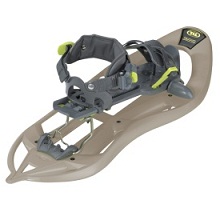
TSL
325 Escape snowshoes
From
50kg - 120kg
Very strong and durable, and give good flotation even
in deep powder. A very versatile all-rounder snowshoe.
Padded ankle strap for comfort. Heel raiser. Bag
for transport / storage included.
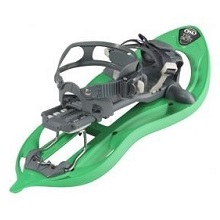
TSL
305 Escape snowshoes
From
30kg - 80kg
This
has the same features as the TSL 325 Escape, but
is for lighter users. Very strong and durable,
and give good flotation even in deep powder. A
very versatile all-rounder snowshoe. Padded ankle
strap for comfort. Heel raiser. Bag for transport
/ storage included.
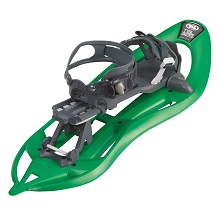
TSL
325 Approach snowshoe
From
50kg - 120kg
Virtually
the same as the 325 Escape, but has a slightly
different binding system. Suitable for the same
range of terrain. A very versatile snowshoe for
Alpine use. Bag for transport / storage included.
TSL
305 Approach snowshoes
From
30kg - 80kg
This
has the same features as the TSL 325 Approach,
but is for lighter users. Suitable for the same
range of terrain. A very versatile snowshoe for
Alpine use. Bag for transport / storage included
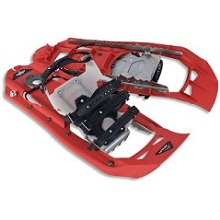
MSR
Evo Ascent 22" snowshoes
Up
to 80kg without tails; up to 114kg with tails
Some
of the toughest snowshoes on the market. PosiLock™
AT bindings. Energy-saving Televator™ heel
lifts help make this a real all terrain snowshoe.
Suitable for all Alpine conditions.
MSR
Lightning Escape snowshoes
From
50kg - 120kg
This
snowshoe offers the premium of traction and performance,
even on difficult snow terrain. The aggressive
Torsion2™ crampons, and 360° Traction™
frames offer ultralight security especially on
traverses. These are the best snowshoe for deep
backcountry access. Four foot straps for secure
fitting.
Photo
of the day - updated every time the page loads
Key
ropework
If you are on a climbing or skiing course,
you may wish to refresh or learn some of the
key knots and ropework before your trip. Click
on a knot on the left to visit the page that
explains the 9 most popular knots that you
might use, as well as the 1:3 and 1:5 rescue
hoists.