On
this page you can assess your current level of fitness,
and will find a table that we use to rate each course
in terms of fitness and stamina required. We also
outline the key principles to consider in terms
of preparing for training, and what type of fitness
you are trying to achieve. We advise on diet and
hydration for sport, types of training to avoid,
and mountain specific training.
Gym
fitness? In the vast amount of cases,
it is highly unlikely that you will be fit
enough from inside gym training. You need
to go outside! These pages give you advice
on to what types of training to consider.
We
are confident that we have provided more information
about the required levels of skills, training and
fitness, than any other guiding company, and it
is an essential part of our service. Obviously we
have no wish for someone to book on a course who
is the wrong level. It would at best frustrate you,
and at the other end of the scale could really impact
on your enjoyment and safety. We ask anyone booking
a course to self declare on the booking form that
they meet the pre-requisite skills and fitness requirements
for the course, so it is your responsibility to
ensure that you are not overestimating your current
level at all. If in doubt, then please err on the
side of caution...
Assessing
the correct level of course fitness
Each course has a graphic
at the top of the page that indicates the fitness and
stamina level required for each course, on a five point
scale. To assess what each level assumes as a level of
fitness, see the table below. These levels of fitness
aren't to scare you, but so you can self assess if you
are fit enough for your course. We have provided examples
of courses that fit into each category, but please refer
to the course itinerary page for the precise grading of
the course, as we cannot possibly fit all of our courses
onto the table here.
Examples
of courses in each key category:
Level
1
This
is the lowest level for any of our courses, and
we would suggest that a 5km run would not pose you
any issues. Obviously, even though this is the lowest
grade, you should be capable of long days out on
the hills, and not get to tired from this, as well
as recovering quickly.
None
of our climbing trips are at this low fitness
level
Chamonix
Intro Via Ferrata
None
of our ski courses are at this lowest fitness
level
Intro
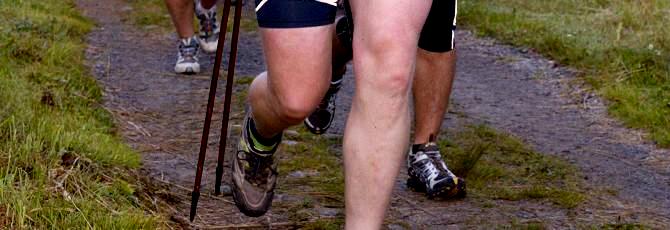
Trail Running Day
Level
2
We
suggest that people on courses of this grade can
run 10km without a problem, but we stress that for
courses of this level you do not need to be any
fitter than this minimum level, though it is there
to ensure a good basic level or aerobic fitness
and training.
Alpine
Intro Courses (both in summer and in the winter)
Acclimatisat-ion
Weekends
Snowshoe Courses
Kilimanjaro
Off
Piste
Vallee Blanche
Intro
Trail & Fell Running Weekends
Level
3
At
this level your fitness should be somewhere between
running a fast paced 10km run, and half marathon
fitness. Typically you'll enjoy more hill training,
and so would be able to run for about an hour and
a half of cross country, and enjoy big hill days
out too.
Tech
Ice & Classics
Ice & Gullies
Mount Elbrus
Corsica
GR20
Alpine Trail Running Camp
Intro
Ski Touring and Backcountry
Chamonix
Trail Running Week
Level
4
As
an absolute minimum you should be capable of running
a half marathon in a good time (under 1hr 45mins),
but realistically you should be looking at marathon
fitness for all courses of this fitness and stamina
level to ensure your endurance is up to standard.
Mont
Blanc Summits
Matterhorn
Eiger
None
of our trek courses are at this very good fitness
level
Haute
Route Ski Tour
Gran Paradiso Ski Tour
UTMB
Recce Week
Level
5
Only
a few of our courses are marked at this level, where
the required minimum fitness level is that of being
capable of running a marathon, though it must be
stressed that the duration of time that you are
exercising for on the course, will be of a greater
duration.
Grandes
Jorasses
Winter Matterhorn
None
of our trek courses are at this highest fitness
level
Ski
Tour up Mont Blanc
Mont
Blanc One Shot
Are
these the actual requirements for the course?
Yes!
We have been operating courses for over a decade, and
have adjusted these requirements to accurately reflect
the physical demands of each course. For example, on a
Mont Blanc course, it states that you should be ideally
marathon fitness, but at least running a half marathon
in a reasonable / good time (i.e. under 1hr 45mins).
No
of course we fully accept that the two are not directly
comparable, but it indicates that you should be
able to exercise at a high aerobic output for at
least 1hr 45mins without needing to stop to rest
/ eat / drink, as your body is accustomed to the
effort and more importantly the quick recovery.
If you arrive for a course, and are not the required
fitness level, and this is to the detriment of others
on the course, it will be impossible for you to
participate in the activities. We advertise pre-requisite
levels of fitness to give you a good chance of obtaining
the course goals. To arrive without this fitness
is a waste of your time and money. It also puts
you (and us) under a huge amount of unecessary stress,
for no reason other than your laziness. Sorry that
this paragraph is blunt, but we know you won't be
offended if you are honestly training as required.
One
aspect that we are seeing increasingly often, is
people coming on courses, who it is impossible to
judge their fitness, as their balance is poor and
their ability over rough broken mountain terrain
is so slow. Mountains where this ability is critical,
include Mont Blanc, the Eiger and Matterhorn. In
a world where people are increasingly taking less
responsibility for themselves, before booking on
a course there is no better judge of your balance
and ability on this terrain than yourself. You need
to assess if you are happy running over scree slopes,
hopping across a boulder field, and with exposure
on steep ground. Balance is a skill that requires
work to improve. If you are moving like a crab over
screes, and are constantly knocking stones down,
then be honest with yourself. Consider increasing
your training on this type of ground, or consider
an easier course.
Preparing for your course
One
of the most ignored aspects of mountaineering is the training
required for the sport. A classic example is people looking
on a map to see the height gain on a summit day, and for
Mont Blanc it is 1300m. People then equate this to walking
up Ben Nevis (same height gain), and blaming any problems
on lack of acclimatisation. To put it bluntly the courses
have been designed by professionals to maximise your acclimatisation,
and if you struggle it is your lack of training that is
at fault, not us. A fitter person acclimatises easier,
and their body is better prepared to work at maximum outputs
for a long time, or where there is less oxygen. Added
into this are the factors of walking in snow on crampons,
and carrying a rucksack. This page outlines how to prepare
yourself in the best manner possible, as it is clear that
the better prepared you are, the more you will get out
of the course.
Muscle groups & aerobic efficiency
The most efficient exercise for
mountaineering is either mountaineering itself, or at
least types of exercise that develop the key muscle groups
and aerobic fitness at a similar level. Except on very
difficult climbs, the main muscle group that will be used
are in the quadraceps (thighs), and the oxygen demand
by this muscle group is high, requiring a good level of
aerobic efficiency. For this reason weight training in
a gym is far less effective than running, as your muscle
capacity can only grow if the aerobic output can meet
the demand. Where there is a shortfall, lactic acid is
produced and you will feel what athletes call the 'burn'.
Recommendations
Our recommendation for the majority
of our courses, is that you should be running for 45 minutes
at least three times a week for the months before the
course. Many people try using the excuse that their joints
get sore with running. Often this is because people are
overweight, and so stress the joints anyway, but here
are another couple of options for you to consider trying:
1) Run on soft surfaces such as grass, as it is easier
on the joints and harder for muscles. 2) Go cycling but
ensure there are lots of hills, & go for 2 hours at
a time, not 45 minutes. When you are truthful to yourself
you probably know that currently you are not training
enough at the moment, and excuses such as 'not enough
time for training', are due to bad time management and
lack of prioritisation. Everyone leads a busy life, and
if you don't get out training, it is you and your course
that may suffer. Excuses are a big sign of weakness! Someone
actually once wrote to complain about these last two sentences.
They clearly had enough time for unecessary e-mails, but
not enough time for training.
Diet
& Hydration
Carbohydrates are foods that release
energy easily, and should only be eaten before exercise
(not after, or before bed). If you eat lots of carbohydrates
without exercising you will put on weight. The food
you eat must provide you with the energy levels you
require, as well as sufficient levels of protein and
fats. It is imperative that you keep hydrated during
your training, or your performance level will drop significantly.
This is especially important to monitor when on your
course, as you will be exercising hard at altitude.
Training to avoid
As well as advising you what training
is good for you, there are a few things to avoid...
Too often we hear tales of people whose only training
involved packing a heavy rucksack and slogging over
a hill. Trainers call this resistance training, but
for Alpine preparation it is useless. It will encourage
you to bulk out muscle groups for carrying heavy loads,
not that you ever carry heavy loads in the Alps at altitude.
The secondary effect is that these non required muscle
groups will burn even more oxygen, which is rare enough
at altitude, and so acclimatisation will be affected.
The tertiary effect of resistance training is the potential
damage to your back and posture that carrying heavy
loads does to you. Getting a slipped disc a month before
your trip to the Alps isn't ideal. Just remember that
all good Alpinists tend to be lean and very fit, not
heavy set and very muscled.
Climbing training
Many people now have an indoor
climbing wall close to them, and this should be seen
as an addition to your aerobic training regime rather
than a substitute for one of the training sessions.
The most efficient way to use a wall is to warm up carefully,
then to climb several routes medium difficulty for you,
one after another, like circuit training in order to
give you an aerobic workout. Then progress onto hard
climbs to test and develop you, and at the end don't
forget to warm down. Why not run to and from the wall
to combine your training?
FREE
training podcasts
FREE
Podcast Training
for Mont Blanc
A no holes barred podcast, to fully
explain what an ascent entails physically
and technically, including several examples
of hill training.
FREE
Podcast
Starting out trail running
A fast growing sport, & this podcast
explains what it involves, how to get
into it, and exactly what equipment
that is required...
We
know how hard it can be to follow a training planner.
Don't think for one minute we aren't aware what we are
asking you to do. We've all been there before, driving
home in the dark in the rain with the prospect of a one
hour run ahead, putting on wet trainers that haven't dried
from the day before, setting off on a run with a hangover
from a party. The key to following a planner is twofold;
firstly enjoying the training, and secondly achieving
goals along the way. To enjoy the training do whatever
you need to stop being negative about it; get good footwear
and clothing, or put your favourite music on your iPod.
Make sure you are comfy and not bored. Trudging round
the block in trainers with heels that rub and a jacket
that leaks isn't fun. The training planners are all for
several weeks, so why not consider entering a race as
a half way goal to keep up the motivation. If you are
building towards half marathon fitness, do a 10km race
about a month into the planner. Look at the Runners
World website to find an event close
to you. Others train to lose weight as well as to gain
fitness, so if you are putting all the effort in, get
sponsored to lose the pounds or to run a race. Time your
regular running routes, and try to beat the times, and
do whatever keeps you happy and motivates you. Really
good luck!
Hill
fitness & scrambling
It
is always important to try and integrate hill training,
scrambling, and climbing (as applicable to your trip)
into addition to your training schedule. This increases
your endurance, balance, and speed of movement over rough
mountain terrain. We stress that this training should
be in addition to your aerobic training, and not be a
substitute to any part of it. A great benefit of hill
fitness is that it cross trains various muscle groups,
and this should help you avoid injury. As is stated in
other pages of this training advice, is that the advice
we offer can only be generic, and you are individual.
Your training plan has to be unique to you. Every person
needs to adapt a plan to suit their exact requirements.
The one aspect this is incontestable, is that the more
you put in, the greater your chances of success!
Why
choose our trips?
See
our Alpine blog, by clicking on the Word-press logo
to the right.
Itinerary
flexibility to allow you to take full advantage
of the weather windows on any day, to maximise your
summit chances.
Our
prices are fixed in £ Sterling, to protect
you from euro fluctuations, so you can budget accurately.
There
is a choice of routes to opt for, depending on the
weather, conditions, and your experience.
Any
further questions?
A
key part of choosing a company is being able to come and
talk about your plans with an experienced course advisor
face to face. In an increasingly virtual world, we know
our clients value speaking to real people, getting open
and honest advice. The vast majority of our clients are
British, and our office and outdoor store is based in
Windermere in the English Lake District.
Get
in contact to arrange a meeting, and come in for a coffee
to discuss your course in person with a trip
advisor.