Alpine
Intro 'Summits & Skills'
2027
1st Alpine 4000m summit | Techniques & skills | Ideal 1st trip    |
|
|
|
|
|
 |
|
Course
overview

 |
 |
Your
first trip to the Alps is your most
important and most rewarding, as you
begin your Alpine climbing career, and
learn safety skills that you will use
for the rest of your life in the mountains. Learning the basics, and doing them well, never cutting corners, is key for any climbers career. |
|
To
join our Alpine Intro course you need
no previous experience of climbing or
mountaineering. This course is suitable
for keen hill walkers, indoor wall climbers,
or ramblers, to introduce you to the
key technical aspects necessary for
mountaineering. If you have more experience, consider the Autonomy course. |
|
A
key feature of the Intro course is that
you attempt an Alpine 4000m peak at the end of the week. It's the highest peak completely in Italy, Gran Paradiso 4061m. It involves a night in a mountain
hut, and an Alpine start
the next morning for the summit.
A great experience, and it will confirm
how much you have learned. |
|
Alpine
Introduction courses focus on the
skills that you will require for ascents
on Alpine rock, ice and snow; including
ropework, glacier travel, navigation,
crampon & ice axe use, and equipment
selection. |
|
Even
if you have had no previous contact
with ropes, or experience of ice
or rock climbing, by the end of the
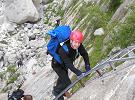
week you will have climbed pitches of glacial ice, a rock route and reached the summit of an Alpine peak. |
|
A
principal feature of this course are
the evening theory sessions, where you
learn the background theory, so that
the daylight hours are optimised for
your climbing time. You can read more
about these instruction sessions, which
cover ropework, Alpine weather, and
crevasse rescue, by clicking
here. |
|
Dates: these
are listed in the column on the right,
and they show the live availability
from our secure online booking system.
When you book online, you receive immediate
confirmation, your Alpine Information
Booklet, course specific kit list and
invoice. |
|
|
|
 |
Brief
Course Itinerary
|
 |
|
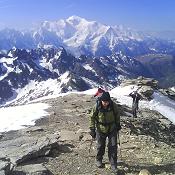
Day 1 | Sunday
Travel to Chamonix. Accommodation check in at 17:00. Mont Blanc specific course safety and itinerary briefing at 17:30.
There is time for kit checks or fitting rental equipment after.
Briefings are over by 18:30 and then you are free to go out for dinner / drinks. Many clients opt
to travel out a day or two early to start their acclimatisation at Aiguille du Midi or with a night in a mountain hut (e.g. Cosmiques or Albert 1er). Night in Chamonix.
 Gallery: Chamonix town Gallery: Chamonix town |
|
|
|
 |
|
Day 2 | Monday
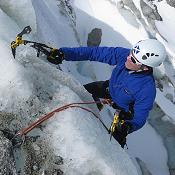
Day
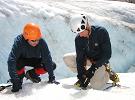
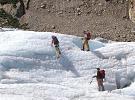
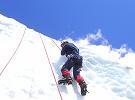
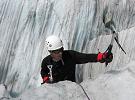
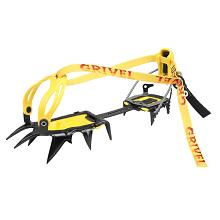
to learn and practice using crampons and ice axes
on the Mer de Glace / Argentiere glacier (2000m). You climb
vertical ice, create ice anchors, and learn glacier
travel skills. This is one of your most important
days of the course in terms of skills development
as it is essential to have good footwork with crampons. Guiding ratio 1:6 (max). Evening
theory session / meeting with course hosts: click
for info.
Night in Chamonix.
Gallery: Mer de Glace |
|
|
|
 |
|
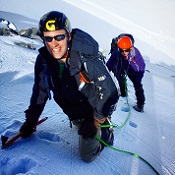
Day 3 | Tuesday
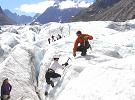
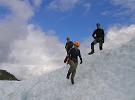
Snow covered glacier travel skills, practising building snow anchors, crevasse rescue, route choice / probing for crevasses. The day is spent with a journey across either the Vallee Blanche, Pointe Lachenal and the Col du Midi, or practising crevasse rescue. The day is essential for your acclimatisation before your main ascent. Guiding ratio 1:6 (max). Evening
theory session / meeting with course hosts: click
for info. Night in Chamonix.
Gallery: Lachenal & Vallee Blanche |
|
|
|
 |
|
Day 4 | Wednesday
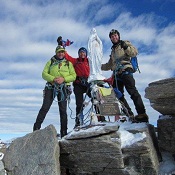
Drive through the Mont Blanc tunnel to Valsavaranches, and Pont at its head, where you trek up to either the Vittorio Emanuele or Chabod mountain hut for the night. There are no cable cars or uplift on Gran Paradiso, which perversely is one of its greatest attractions, in that the ascent is human powered all the way. The hike up to the hut is through stunning scenery in the national park. Guiding ratio usually 1:3 (up to 1:4 max).
Gallery: Gran Paradiso 4061m |
|
|
|
 |
|
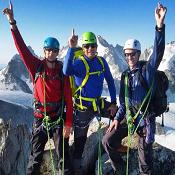
Day 5 | Thursday
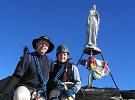
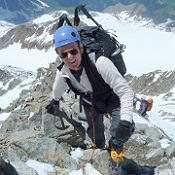
After an Alpine start, you set off in the dark, to reach the glacier, where you put on crampons and ascend to the plateau below the summit ridge. Here the route steepens, and you leave the snow for the rocky scramble on the top section to reach the summit. Descend the same route via the hut to collect anything you have left, to reach the valley in mid afternoon. Return to Chamonix for the night. Guiding ratio usually 1:3 (up to 1:4 max).
Gallery: Gran Paradiso 4061m |
|
|
|
 |
|
Day 6 | Friday
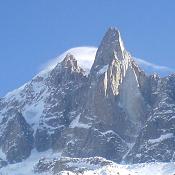
Meet your guide in the morning, and after the main ascent the day before, today is more flexible to see how much energy you still have in the tank. Many groups want to develop more skills on this day, be it building anchors and belays on rock climbs, or learning how to abseil safely. Ropework is a common focus of this session, for you to learn skills to develop in the future. Guiding ratio 1:6 (max). Night in Chamonix.
Gallery: Alpine skills |
|
|
|
 |
|
Day 7 | Saturday
Breakfast then the accommodation check out by
10:00. Most arrange transfers for around this
time for a flight from Geneva about midday. Some
opt to book a tandem paraglider flight in
the morning, or to go rafting, mountain biking, or trail running, if you still have the energy! Our resort team can advise you on where to arrange any of this, or routes. For those departing late, bags can be stored during the day. Depart for home.
Gallery: Icicle Windermere office |
|
|
| ITINERARY
NOTES: Where possible we follow itineraries. Mountain
adventures are weather and conditions dependant,
so occasionaly we are forced to alter the plans.
If this is the case, suitable alternatives are offered.
Please use this itinerary as a guide to the types
of route / activity you attempt. |
|
 |
|
|
Course
Prices
|
| Standard
course |
5 days guiding, 7 days holiday in total
IFMGA mountain guides for 5 days |
£1345 |
| Live
availability |
Click
on the planner logo to the right to
see the real time live course availability
|
 |
| How to book |
Secure
payments, bonded tour operator
Details of how to book, click
here |
Book
online |
|
|
|
| Standard
Course Inclusions |
|
 |
1) Hand picked IFMGA Mountain Guide(s), including 5 days guided activities |
|
2) Chamonix course hosts for briefings, logistics, expert advice, and support |
|
3) Pre course information dossier, with training plans and specific kit lists |
|
4) Safety briefing on the first evening, with latest updates and weather reports |
|
5) Equipment discount voucher for our Windermere mountain shop / online |
|
6) Self-catered flat in Chamonix for 6 nights, with no moving out when in huts |
|
7) One night half board in mountain hut on Gran Paradiso (inc. costs for guides) |
|
8) Road transport with your guide to / from Valsavaranches, tolls and tunnel |
|
9) Evening drop-in sessions for instruction / route briefings / equipment advice |
|
10) Free 36 page
technical Course Instruction Booklet of Alpine safety skills |
|
|
| Exclusions:
1) Travel to and from Chamonix, 2) Equipment hire,
3) Cable cars & uplift (c. 80 euros depending
on itinerary) for you (and guide if required), 4) Lunches & snacks for during the days, 5) Breakfasts and evening meals in Chamonix, & any purchases in mountain
huts, 6) Activities insurance. |
|
 |
Course
upgrade options
Many clients on this
trip consider upgrading with one or more of
the following course additions... |
|
|
|
| |
 |
|
Private
room |
|
 |
|
Big
5 Alpine
extensions |
|
 |
|
Technical
kit rental |
|
 |
|
Acclimatise
weekend |
|
|
|
|
|
|
| |
Upgrade
to single from
£300-£500 in addition to
standard course price,
depending on week. |
Extend by 2 days after
to ascend one of the
Big 5 Alpine peaks as
an extra summit. |
Rent all technical kit
for a week. Full Alpine
Bundle costs you just
£100 for the week. |
Saturday
night spent in
Chamonix, with choice
of self-guided or guided
on Sunday. From £70. |
| |
Click
for details |
Click
for details |
Click
for details |
Click
for details |
| |
Standard
course accommodation - normally clients are based
in self-catered flats (details),
so take a look, and decide if it's for you. For
more luxury, contact us for quotes in higher standard
apartments, or hotels of any standard required.
If you have / source your own course accommodation,
or we cannot provide an upgrade, the standard course
price has a £200pp reduction applied on your
invoice. |
|
|
 |
|
|
Current
course availability
|
|
| Testimonials |
|
|
|
|
|
|
|
| Press
& media |
|
|
|
|
| Films
& videos |
|
|
|
|
| Photo
gallery |
|
|
|
|
|
| Location
data for this trip |
|
|
 |
|
| The
trips are based in the Chamonix valley in the French
Alps, at the foot of Mont Blanc. It is easily accessed
via a 90 minute transfer from Geneva airport. |
|
Time
Difference
GMT +1hr |
Local
Currency
€ Euros |
Travel
from UK
1hr flight |
|
|
| Why
choose this course |
|
|
| This
course is genuinely one of our favourites to run,
as those booking on it are declaring that they want
to learn as much as they can, and are seeking to
kick start their Alpine career by getting the key
skills and knowledge, before they attempt some of
the bigger and harder routes. This is a great attitude
with which to begin Alpine climbing, and is a very
sensible approach
if for example you have never worn crampons before. |
|
| Alpine
skills & knowledge |
|
|
Try
to answer the questions below, and see how much
you already know. The answers are beneath. After
you complete one of our Alpine Intro courses, you
should be able to answer all these questions, and
much more with the greatest of ease.
Q1.
What is the minimum length rope two climbers should
take for a wet glacier crossing?
ANSWER:
They should take a 30m rope, as a wet glacier is
snow covered, so crevasses could be hidden. Each
climber should tie on the end of the rope and take
in chest coild until 10 to 12 metres are tied off
between them.
Q2.
What is a foehn wind, and how is it generated?
ANSWER:
A foehn wind is caused by the enforced uplift of
an airmass over a mountain, and as it cools with
altitude the humity condenses and precipitation
falls. On the descent the drier air mass is rapidy
compressed and warms quickly. The net effect is
that the air reaches the same altitude on the far
side of the mountain drier and warmer than on the
uplift side.
Q3.
How can you retreat from a multi-pitch ice / glacier
climb without leaving any ice screws behind?
ANSWER:
By constructing Abalakov belay systems, which are
two inter-connecting holes drilled into the ice,
using ice screws, through which some abseil tat
is threaded and tied off.
Q4.
How do you tell a left and right crampon apart?
ANSWER:
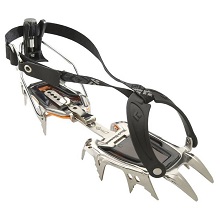
The buckles / strap attachments are always on the
outside of the crampon, to reduce the snagging /
trip hazard. Also looking a the crampons from above,
a left boot crampon bends to the right, and vice-versa. |
|
| Suggested
reading and kit |
|
|
|
|
 |
View
full course equipment list,
with examples of kit, click
here |
|
|
| Why
choose our trips? |
|
|
|
See
our Alpine blog, by clicking on the Word-press
logo to the right. |
|
|
Itinerary
flexibility to allow you to take full advantage
of the weather windows on any day, to maximise
your summit chances. |
|
Our
prices are fixed in £ Sterling, to protect
you from euro fluctuations, so you can budget
accurately. |
|
There
is a choice of routes to opt for, depending
on the weather, conditions, and your experience. |
|
|
| Any
further questions? |
|
|
A
key part of choosing a company is being able to
come and talk about your plans with an experienced
course advisor face to face. In an increasingly
virtual world, we know our clients value speaking
to real people, getting open and honest advice.
The vast majority of our clients are British, and
our office and outdoor store is based in Windermere
in the English Lake District.
 
Get
in contact to arrange a meeting, and come in for
a coffee to discuss your course in person with a trip
advisor. |
|