Acclimatisation
weekends 2027
Extend your Chamonix
course, to maximise your acclimatisation
Course
overview
This
is a course extension, for those on a week
long course such as Monte Rosa or Mont Blanc or the Matterhorn,
who wish to kick start or enhance their acclimatisation.
You arrive in Chamonix on the Saturday afternoon
or evening on any flight that suits, and have
accommodation in town for the night, before
a choice of self-guided or guided acclimatisation
day options to suit the following day.
We
run these Acclimatisation Weekends in Summer
(from June to September), every week of the
season before a scheduled course. On most
weeks roughly quarter of all clients opt for this,
as the guiding on the scheduled course is
five days, so if weather dictates an earlier
main ascent, you will not be very acclimatised
without considering one of these extensions.
For
those who opt for guided activities on the
Sunday, we always ensure that they are over by mid-afternoon
to allow you to descend and return to Chamonix
by 16:30 on Sunday, so that you can freshen
up for the 17:30 main course briefing.
Booking
this weekend is a case of stacking some of
the odds in your favour. We don't guarantee
that you will be fully acclimatised, or that
it will ensure you summit your main peak in
a course after the weekend, nor is it any
training substitute. It is simply one tool
that many choose to increase their chances.
If you really want to acclimatise well, book
a two week course e.g. Mont
Blanc Achievements or Mont
Blanc Autonomy.
If the
Aiguille du Midi cable car is closed for weather or maintenance,
and you are looking for a self-guided
option for activities on the Sunday, here are two obvious alternative
options to consider;
1) Skyway 3500m - take the bus from Chamonix
Sud (08:30 first bus) to Courmayeur, and
catch the Skyway lift to Helbronner. This
is the equivalent of the Aiguille du Midi
on the Italian side, and to stay the day
at that altitude would be great acclimatisation.
2) Grands Montets 3295m (currently closed following a fire, hopefully re-opening in 2025) - catch the free valley
bus to Grands Montets in Argentiere, and
ascend to the the top of the cable car.
This is slightly lower than the Skyway,
so is definitely a second option.
How long should you stay up there? All day
long! Go up on the first lift, and descend
as late as possible, in time to get back
for the 17:00 course briefing.
Dates: these
are listed in the column on the right, and
they show the live availability from our secure
online booking system. When you book online,
you receive immediate confirmation, your Alpine
Information Booklet, course specific kit list
and invoice.
Acclimatisation
weekend options...
On
the Saturday you travel out to Chamonix, where your accommodation
is provided for the night. Below are the options for activities
on the Sunday, so you can select a method of acclimatisation
which suits you best. Note your preference on the course
booking form (select the acclimatisation weekend date
below your course option, and detail your activity option
in the 'Notes for Icicle' section on the form). The night
of accommodation is guaranteed from the time of booking.
Let us know at the time of booking if you prefer the self-guided
option (i.e. just the £75pp for the night), or of
you wish to add a private guiding supplement to your invoice
(i.e. £75pp for night + guiding).
Option
1
Self-guided acclimatisation
Option
2
Supplement for private
guiding
This
is the most popular choice for the weekend, to allow
you to undertake a self-guided day. Below is an
outline of a frequently used itinerary for the day,
that obviously is subject to your experience, weather
and the conditions. It is only a suggestion.
Alpine
guided climb
From £450 (up to 2 clients)
Enjoy an extra day of high mountain guiding, from
one of the top cable cars (Aiguille du Midi or Grands
Montets) for a warm up route such as the Pointe
Lachenal or Petite Aiguille Verte.
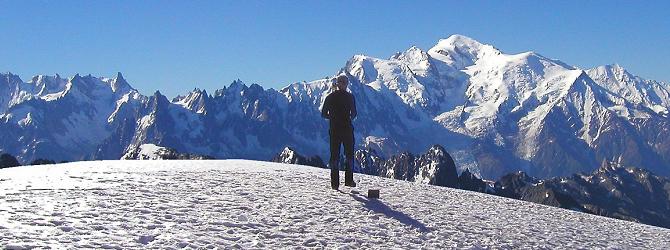
If
you get up quite early, you can beat the queues,
and extend your cable car pass by a day (c.15€
extra) and ascend to the Aiguille du Midi 3842m.
This is the highest cable car in the Mont Blanc
massif, and you are whisked up to the top in just
over 20 minutes. It's worth spending 3 or 4 hours
up there to really kick start the acclimatisation
process. There's viewing terraces, cafes, toilets,
and even a restaurant, but just doing the tourist
'thing' will take a good few hours, and it's a photographers
paradise.
Guided
trekking peak
From £350 (up to 6 per)
Ascend the highest trek peak in the Mont Blanc massif
in a day. Mt Buet 3109m involves trekking 1800m
of ascent, usually 4 hours up and 3 hours down.
A big hill day, but hugely rewarding.
At
around lunchtime, you could descend to the mid station,
at Plan d'Aiguille, and hike across to Montenvers.
This balcony trail walk only takes about two hours
maximum, and as it's over 2000m, you are boosting
acclimatisation still, without using much precious
energy. When you reach Montenvers, you can use your
cable car pass (it covers all the uplift in the
valley) to catch the train back down to Chamonix,
and you'd be back in plenty of time before the course
into & safety briefing at 17:30.
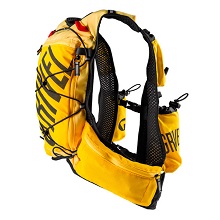
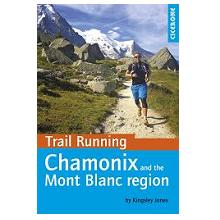
Guided
trail running
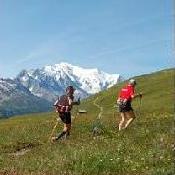
From £300 (up to 4 per) Many train for courses
by running, and Chamonix is the European mecca of
trail running. Join one of our experienced ultra-trail
guides for a c.20km run on one of the most classic
trails above the valley.
Why
is acclimatisation so important?
You
will already be aware that acclimatisation is essential
in the mountains. It takes an average person about
10 days to get 80% acclimatised, and five weeks
to increase this to 95%. In other words you will
never be fully acclimatised for a week long Alpine
course, but every day building up your acclimatisation
counts.
These
options are all conducted around 2000 - 3800m, at
which altitudes you will really develop stimulation
of the red blood cell production. These are the
blood cells that carry the oxygen around your body.
We
abide by the rule of climb high and sleep low, but
don't expect to get a great nights sleep at your
first night at altitude. Some people notice they
sleep lightly the first night they are in Chamonix
at 1030m!
By
gaining height slowly and carefully you are maximising
your chances of acclimatising further during your
stay in the Alps, to make a safe and realistic attempt
on one of the larger summits.
Course
itinerary
Saturday
You can get flights and transfers to arrive in Chamonix
at any time on Saturday that suits you. The course
accommodation will be available for check-in's from
16:00, but equally don't worry if you get an evening
flight, as you can check in later too. Our objective
is to be as flexible as possible for these weekends,
to make them as accessible as possible for the maximum
number of clients. If you check in at 16:00 (sorry
we can't get you in earlier, as the flats are still
occupied, then being cleaned), our resort team can
advise you on kit and weather for the following
day. The accommodation is self-catering, so
in the evening you can cook in or eat out at one
of the restaurants in town. Most people get an early
nights sleep.
Sunday
After
breakfast you follow your chosen activity for the
day. For all of the guided options, the normal meeting
time is at 08:30am, so ensure you've adjusted your
watches and alarms! For those attending a guided
activity, meet at the course meeting point (see
Course Instruction Booklet for map) at 08:30 ready
to set off straight away, with any snacks or lunch
that you require for the day. There is a great bakery
close to the accommodation, which sells a wide choice
of sandwiches and patisserie. All the activities
aim to descend and return to Chamonix in time to
freshen up before your main course briefing at 17:00,
which includes equipment checks, and information
for the week.
ITINERARY
NOTES: Where possible we follow itineraries. Mountain
adventures are weather and conditions dependant, so occasionaly
we are forced to alter the plans. If this is the case,
suitable alternatives are offered. Please use this itinerary
as a guide to the types of route / activity you attempt.
Course
Prices
Standard
course
1 night accommodation, Saturday night.
Note this is room only, as Option 1 above
£75
Live
availability
Click
on the planner logo to the right to
see the real time live course availability
How to book
Secure
payments, bonded tour operator
Details of how to book, click
here
Note
that all the guided options for the Sunday are for private
groups, not collectives that are matched together, and
the prices are in total. If you want guaranteed guiding
on the Sunday, you need to book a private guide.
It
made all the difference to me for coping
with the altitude on Mont Blanc, and
six great days guiding! Stephen
H , Acclimatisation
Can
I just take this opportunity to say
thank you so much for the weekend guiding.
I got my bearings, learnt about the
region, and gave me strong hill legs
for the rest of the week. Thanks John
H-A , Acclimatisation
Thank
you so much for a brilliant week. We
learnt more than we thought there was
to know, which is down to the professionalism
of the guides, & the great set up
you have Lizzie
S , Acclimatisation
Testimonials
Press
& media
Films
& videos
Photo
gallery
Location
data for this trip
The
trips are based in the Chamonix valley in the French Alps,
at the foot of Mont Blanc. It is easily accessed via a
90 minute transfer from Geneva airport.
Time
Difference
GMT +1hr
Local
Currency
€ Euros
Travel
from UK
1hr flight
Films
& photo gallery
Extra
nights in huts?
The
options detailed on this page are for those seeking accommodation
in Chamonix on the Saturday night, and either self-guided
or guided activities on the Sunday.
If you are determined
to maximise your acclimatisation, another option to consider
is to check in to our accommodation at 16:00, then to
catch one of the last cable cars up the mountain to stay
in nearby mountain huts.
Examples of these are the Plan
d'Aiguille hut (10 mins from the Midi middle station),
the Bellachat hut (45 mins walk from the Brevent cable
car), Flegere hut (next to the Flegere cable car), or
the Montenvers hotel (next to the terminus of the Mer
de Glace train).
You could book all these huts directly
yourself from their websites. All these options are at
around 2000m, and do not require any glacier travel or
mountaineering skills to access them, as essentially they
are trekkers huts.
If you are determined to acclimatise
well, an extra hut night might really make the difference!
View
full course equipment list,
with examples of kit, click
here
Why
choose our trips?
See
our Alpine blog, by clicking on the Word-press logo
to the right.
Itinerary
flexibility to allow you to take full advantage
of the weather windows on any day, to maximise your
summit chances.
Our
prices are fixed in £ Sterling, to protect
you from euro fluctuations, so you can budget accurately.
There
is a choice of routes to opt for, depending on the
weather, conditions, and your experience.
Any
further questions?
A
key part of choosing a company is being able to come and
talk about your plans with an experienced course advisor
face to face. In an increasingly virtual world, we know
our clients value speaking to real people, getting open
and honest advice. The vast majority of our clients are
British, and our office and outdoor store is based in
Windermere in the English Lake District.
Get
in contact to arrange a meeting, and come in for a coffee
to discuss your course in person with a trip
advisor.