Advice
from real experts...
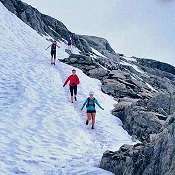
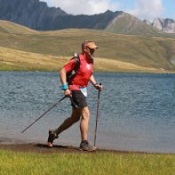
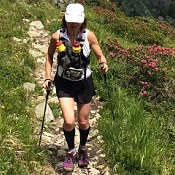
All of our trail running
guiding team live in the Alps, and participate
in trail races on a regular basis. Their running
and guiding experiences make them ideally
positioned to advice you well, whilst you
are out in the Alps. Some of the guiding team
are also sponsored for trail running.
North
Face Ultra Trail...
Each year Chamonix welcomes
thousands of ultra trail runners from all
over the world to compete in the infamous
Ultra Trail du Mont Blanc. The UTMB starts in Chamonix, and makes a full circuit of Mont Blanc,
with over 9000m of vertical height gain, and
a total distance of 170km. It is no small
wonder that this race is one of the hardest
ultra trails in the world, and why it fills
up so quickly with runners each year. The
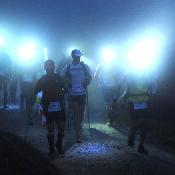
photo above is of one of our guiding team
crossing the line at 06:00am to finish the
UTMB CCC race. To help runners prepare for
the UTMB races, North Face and Overstim teamed
up to produce a brilliant set of short films
on a variety of important facets of training
and preparation. Click on any of the films
below to watch the episode.
Minimum
environmental impact ...
Trail running events have
traditionally been critisised for their environmental
impact, the pollution of travelling to the event,
the mountains of drinks cups and water bottles.
We run our trail running courses with the aim of
minimum environmental impact. We carry rubbish out
off the mountain, and use public transport where
possible.
Trail
running advice; training & kit...
It
is generally agreed that trail running is
a lot better on the bones joints, than road
running on the flat, yet you get all the same
benefits of improved fitness, aerobic indurance,
and weight loss too.
As
trail running is over a variety of terrain
and gradients, most trail runners do not suffer
typical road running injuries and conditions,
such as shin splints and knee problems.
Whilst
the benefits of trail running are clear to
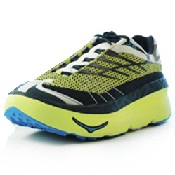
see, it is essential that you have suitable
footwear. Unlike road running, where it is
generally flat and on the same surface, trail
runs involve you running and jumping on all
sorts of uneven terrain, with a wide variety
of surfaces underfoot from wet grass to scree
and mud.
You
should ensure that your trail running shoes
offer you the correct level of support as
well as suitable levels of traction, so that
you don't slide about. Another factor to consider
in the choice of trail running shoe, is that
they suit your stride length. Some people
lope uphill with long strides, whereas others
really shorten their stride and run in a compact
style.
Never
neglect the details in the clothing you select.
As everyone who has ever run in a bad pair
of socks can testify, no matter how good the
shoe, the choice of socks is crucial too.
Ensure
that you wear technical wicking base layers
on your upper body to protect you from the
UV of the sun, to transport moisture away
from the skin, and to cover you in case of
a fall or slide.
Trail
running is famed for the development of lower
leg (calf) strength, as well as increasing
your core strength and balance too. The varied
terrain ensures that you use your stomach
musles, ankles, feet and achilles tendons
in a variety of positions and movements, which
ensures more rounded training, and less risk
of RSI style injuries through repetative movement.
The
variety of movement is responsible for more
holistic and rounded muscle development, than
road running, which is useful if you undertake
a variety of other sports too.
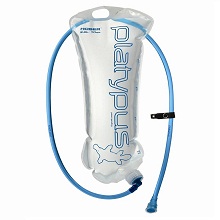
In
terms of diet and hydration whilst on a trail
run, we advise electrolyte laden powders that
can be added to your hydration system (bottle
or bladder systems). Everyone has their prefered
energy foods, such as bananas, energy gels,
trail mix, or over Savoyard sausage. Whatever
works. The key is to stop the blood sugar
level drops, and to take on enough fluids
to ensure the sugars can be broken down too.
Selection
of summer trail routes...
Montenvers
to the Plan d'Aiguille - this is one of our
favourites, and you really feel you are in
the mountains. You take the mountain railway
up to Montenvers and the glacier of the Mer
de Glace, then the trail ascends to the high
point at Signal Forbes. From here you follow
the Gran Balcon Nord across towards Plan d'Aiguille.
Nid
d'Aigle (Eagle's Nest) to Les Houches - to
discover the Western side of Mont Blanc opens
a different panorama, and the run from the
high mountain railway station at Nid d'Aigle
descends towards Bellvue via Mont Lachat.
You can extend the run towards Le Prarion,
or follow some tracks to reach Les Houches.
Argentiere
to Barberine - this run is the best for staying
relatively low on forest and alpage tracks,
exploring the two valleys of Chamonix and
Vallorcine, as well as crossing the watershed
at the Col des Montets. This run can be shortened
or lengthened to suit how you feel on the
day.
Col
des Montets to Planpraz - if you are after
a longer run, this is quite a tough one. At
first the trail is flat, then it ascends steeply
to the Flegere ski area, before a wonderful
balcony run across to Planpraz. The wise can
even opt to start this run at Flegere, and
just enjoy the run across to Planpraz or Brevent.
The
Italian Val Veny and Val Ferret - for an international
feel, why not escape to Italy for a day and
run along the valley floors of either the
Val Veny or Ferret. At the end of each valley
is a hut (Elizabetta or Elena), and you can
return by a different trail to return to your
starting point.
Chamonix
Petit Balcon's & River Trail - an absolute
classic that starts in Chamonix centre and
ascends through the forests to Argentiere,
then returns along the track beside the Arve
river. Still a technical run in terms of tree
roots and rocky trails, but nice on hot days,
as it is mainly in the shade.
Selection
of winter trail routes...
Vallorcine
and Les Granges - there are hundreds of snowshoe
trails that lead through the woods, and the
route can be tailored to how far and how high
you would like to go. An absolute gem.
Italian
Val Ferret - this is a classic snowshoe running
trail from Planpincieux to Lavachey and for
those undaunted by a steep hill climb, up
to the Bonatti refuge at just over 2000m.
Lavencher
and Tines Circuit - a favourite forest trail
route in the Chamonix region passing through
small villages that have remained untouched
by time, and offer a real flavour of how Chamonix
used to be.
UTMB
films ...
If
you would like to see what the North Face Ultra
Trail du Mont Blanc actually involves, then you
can click on one of the reconnaisance training run
films below. The full circuit has been split into
four sections from Chamonix to Chapieux, then to
Courmayeur, Champex, and finally back to Chamonix
at the end. The race normally starts at 18:30pm
in Chamonix, and the quickest runners finish in
just under 24 hours, after running through one night
and a full day. The last finishers will have run
two nights and two days before the 48 hour cut off
time.
If
you would like to read more about our trail
running exploits, click on the RSS logo to
the right, to launch our Alpine trail running
blog posts.
FREE
Podcast
Getting into trail running...
Trail
running is a fastgrowing sport, and
this podcast explains what it involves,
how to get into it, and also goes through
all of the equipment that is required.
FREE
Resource - Fell &
Trail running kit list...
If you are planning on attending one
of our trail running courses, you can
see a kit check list of the clothing
and equipment that we recommend you
take.
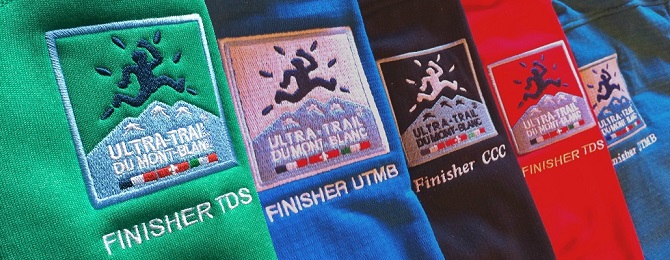
The
photo above sums it up. All of these finisher jackets
of the UTMB race series belong to our head running
leader. We genuinely think that there is no other
operator out there who is more credible!
There
are several other operators who also offer trail
running camps, and we aren't afraid to advertise
that fact. Please look at their itineraries to see
how they differ from ours.
We
don't offer talks from 'celebrity' runners, or go
in for the chardonnay in a hot tub 'lifestyle',
or quasi-scientific courses. Ours are run by people
who do it, not talk the talk.
The
effect on our prices is that we can offer you great
value. We genuinely believe that you'll spend more
time actually running and in the mountains on our
courses, than with anyone else.
Anyone
who is leading you will be a finisher of one of
the iconic trail races, such as the Ultra Trail
du Mont Blanc, Tor du Geants or Leadville or WS100.